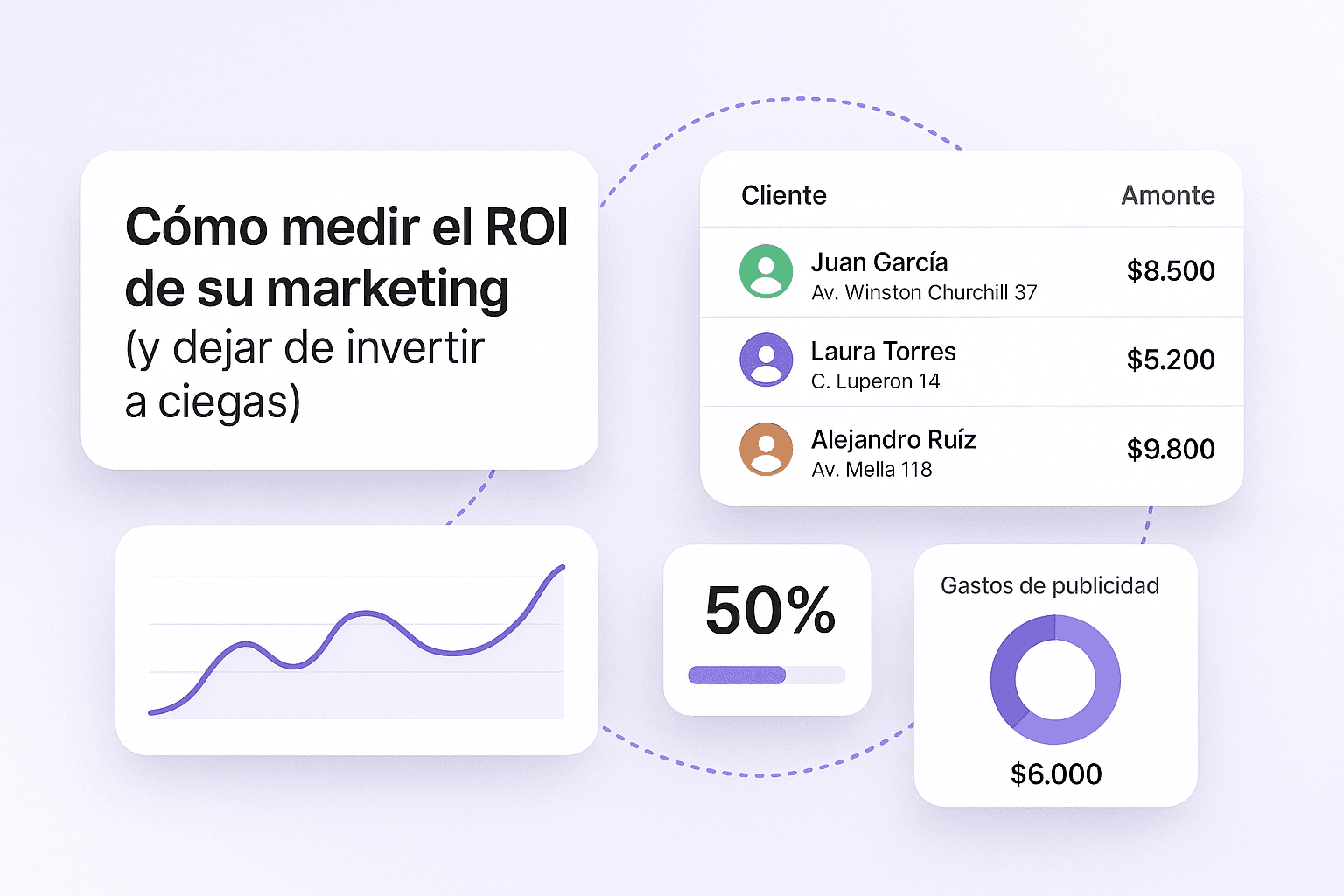
Spending on marketing without measuring the return is like filling the tank without knowing where the car is headed. Sooner or later someone asks: "all that advertising money — what did it bring in?" If you cannot answer in numbers, you are flying blind. Here is how to measure your marketing ROI so you can decide with data instead of instinct.
What ROI is, without the jargon
ROI — return on investment — answers one simple question: for every dollar I put into marketing, how much came back? The basic formula is (revenue generated − cost of the investment) ÷ cost of the investment. Put $10,000 into a campaign that produced $30,000 in attributable sales and you returned 2× on what you spent. The formula is not the hard part; attributing the right sale to the right effort is.
Start with the objective, not the tool
Before measuring anything, decide what that spend was supposed to do. "Grow online sales" is a different job from "feed the sales team qualified leads" or "win back customers who stopped buying." Each one is measured differently. A well-set objective is specific, realistic and measurable: "twenty new quote requests a month from the website," not "more presence on social." Without that clarity, any number you report is decoration.
What is actually worth measuring
- Cost per acquisition. What it costs you to win one new customer through each channel. This is the figure that separates a profitable channel from one that just spends.
- Conversion rate. Of every hundred people who reach your site or landing page, how many do the thing you wanted. Improving this often returns more than buying more traffic.
- Customer lifetime value. A customer who buys once is not worth the same as one who comes back every month. Marketing that brings recurring customers is worth more, even when each acquisition costs more.
- Attribution by channel. Knowing whether the sale came from search, social, email or word of mouth. Without it, you do not know what to switch off and what to double.
The mistake of measuring vanity instead of business
Likes, followers and reach feel good, but they rarely cover payroll. A video with fifty thousand views that produced not a single inquiry is entertainment, not marketing. The metrics that matter are the ones tied to money: leads, sales, cost per sale, return. If a metric does not help you decide where the next dollar goes, it probably does not belong in your report.
The short version
Measuring ROI is not a year-end accounting exercise; it is the dashboard that tells you, month by month, which channel deserves more budget and which one to cut. Set the objective, connect every effort to a real sale, and stop paying for applause. Marketing that is not measured in sales is an expense dressed up as an investment.
We operate marketing on data: we measure what produces sales — not followers — and move budget toward what actually converts. See how in our digital marketing service, or build your project in minutes.
We do not just write about this. We build it and we run it.
Stores, integrations, websites and intelligence already in production. Serving North America and LATAM since 2008.