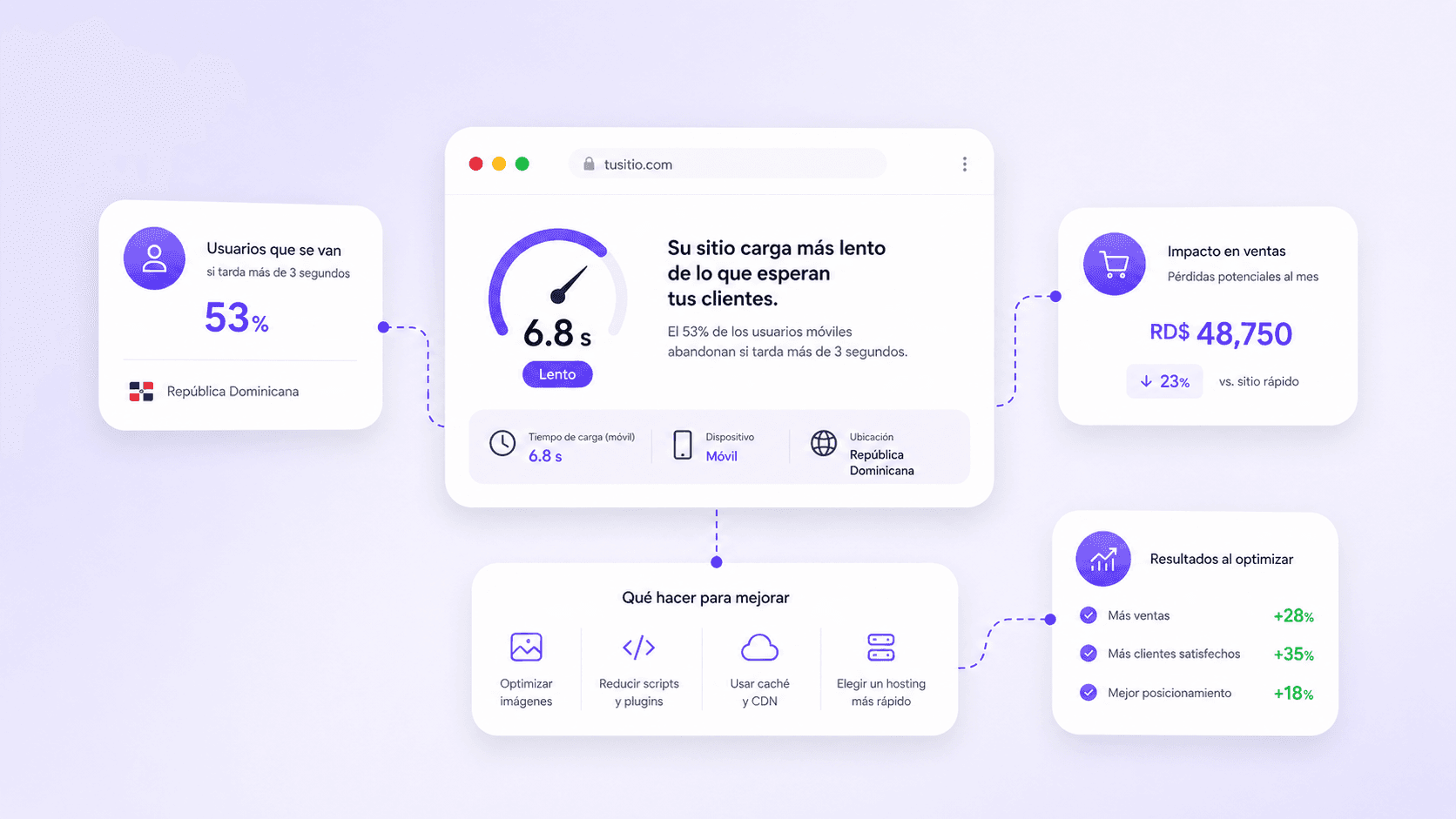
Three seconds. That’s roughly how long your customer waits for your site to load before closing it and going somewhere else. They don’t warn you and they don’t complain: they simply leave, and you never hear about the sale that didn’t happen. A slow website is one of the most expensive and most silent customer leaks there is, because it doesn’t fail outright — it opens, eventually — it just loses people along the way, every single day. Here’s how to tell whether yours is slow and, above all, what to do about it.
Calculator · sales slipping away
Move the sliders and see how many visitors a slow site could be costing you every month.
A fast site loads in under 2.5 s.
Visitors you could lose each month
480
≈ 24% se va antes de ver su sitio. Cada uno era un cliente posible.
Measure your site with Google
Enter your address and see your real speed, measured by Google. It takes a few seconds.
Why speed costs you money
Slowness hits from three sides at once. The first is direct: for every extra second it takes to load, a share of your visitors leaves before seeing anything at all. On mobile data — where most of your traffic arrives — a heavy site is a wall. The second is Google: speed is a confirmed ranking factor, so a slow site sits lower in the results and gets fewer visits to begin with. The third is trust: a site that drags reads as careless, and a customer who doubts your site doubts your business. Slow isn’t a technical detail: it’s lost sales, lost rankings and lost trust.
Signs your site is slow
You don’t need to be technical to suspect it. If any of this sounds familiar, you have a problem:
- On a phone, on mobile data, it takes a while to show anything and you stare at a blank screen for a few seconds.
- Images drop in piece by piece, blurry first and sharp later, or the text jumps around while the page loads.
- Customers message you asking for information that’s already on the site, which means they didn’t wait for it to load.
- You get plenty of visits but few inquiries or sales: people arrive and leave.
- You avoid opening it on your own phone because “it gets slow.”
How to measure it properly, not by feel
Your impression lies, mostly because you open your own site over your own wifi with the page already cached, so it loads fast for you. Your customer opens it for the first time, on mobile data, on a mid-range phone. That’s the real test. To measure it with numbers, Google offers free tools that give you a speed score and tell you exactly what’s holding the page back. What matters isn’t a perfect grade — it’s understanding what’s heavy and why. Use the list below for a quick diagnosis on your own.
Is a slow site costing you sales?
Check what your business already does.
Why your site is slow: the real causes
It’s almost always a combination of these, and almost all of them are fixable:
- Unoptimized images. The number one cause. Enormous photos, several megabytes each, uploaded exactly as they came off the camera or the phone. The browser has to download all that weight before it can show them.
- Cheap or overloaded hosting. Slow hosting, shared with hundreds of other sites, responds late to every visit. The three-dollar-a-month plan gets paid for in lost customers.
- Too many features and old plugins loading dead weight. Sites built in a hurry collect extensions that are heavy, that conflict with each other and that drag the whole page down.
- None of the optimization that makes a page load fast on every visit. Without those techniques, each visitor rebuilds the page from scratch instead of receiving a version that’s already prepared.
- Careless construction. An overloaded template or a poorly assembled site carries weight nobody can see but everybody waits for.
What to do, from the quick fix to the real one
There are two levels of answer, depending on how deep the problem runs.
Targeted fixes: compress the images, strip out what’s no longer used, and move to hosting that actually responds. For a site that’s fundamentally well built, this can recover a lot with very little work. It’s the first thing worth trying.
The real fix: when the site sits on a heavy, dated foundation, patching it is putting new tires on a car with a damaged engine. It improves for a while and then fails again. What pays off there is rebuilding it on a modern, lightweight foundation while keeping the rankings you’ve already earned in Google. It costs more than a patch, but it actually solves the problem instead of starting over every six months.
Speed is maintained, not fixed once
Here’s the part almost no business accounts for: speed degrades on its own over time. Every new unoptimized image, every new feature added, every update left pending slows it down again. That’s why a one-off “fix” means little if nobody is watching afterward. What keeps a site fast is somebody operating it: backups, updates, images that arrive already optimized, and an eye on the numbers every month. Without that, a year from now it’s as slow as it is today.
How we look after speed
When we build a site, performance isn’t an extra: it’s part of the work from day one, on a lightweight foundation and hosting that responds. And when we rebuild a slow one, we protect what it already earned in Google so it doesn’t lose visits in the move. After that, part of what runs behind the scenes watches the speed on its own: images come in optimized, updates get applied on time, and you hear about it if something starts to drag. The site stays fast without you having to keep an eye on it.
The short version
A slow website costs you sales you never see, rankings in Google and the customer’s trust. Measure it the way your customer sees it — phone, mobile data, first visit — not from your own wifi. The usual causes are heavy images, cheap hosting and careless construction, and nearly all of them have a fix: sometimes optimizing and cleaning up is enough; sometimes, when the foundation has aged out, rebuilding while protecting the SEO is the better call. What never works is ignoring it: a slow site does not get better on its own.
We rebuild slow sites on a fast foundation, without losing your Google, and we keep them that way. See our website redesign service, or build your project in minutes.
We do not just write about this. We build it and we run it.
Stores, integrations, websites and intelligence already in production. Serving North America and LATAM since 2008.