It happens to every online store: the customer arrives, browses, picks something, adds it to the cart and then, right before paying, disappears. That isn’t bad luck. Of every ten people who reach the cart, most leave without buying, and almost always for reasons you can fix. Here’s why those sales get lost and how to win them back, without blaming the customer.
What an abandoned cart is, and why it matters
An abandoned cart is a sale that came within one step of closing and didn’t. The customer already showed intent to buy: the hard part, attracting and convincing them, was done. That’s why recovering carts is the easiest money in your store — you don’t have to find a new customer, you only have to finish collecting from one who already wanted to pay. Every cart that leaves unpaid is margin left on the table.
Why the customer doesn’t finish paying
The reasons repeat across almost every store, and they rarely have anything to do with the price of the product:
- The checkout is long and confusing. If paying means creating an account, filling in fifteen fields and hunting for the button, the customer gets tired and leaves.
- Their payment method isn’t there. If your store doesn’t take the cards and wallets your customers reach for — the ones already saved on their phone — many of them have no way to close the sale.
- Costs that appear at the end. The customer sees a price, gets to checkout, and suddenly shipping and taxes are added on top. That surprise kills the purchase.
- The store doesn’t inspire confidence. No security certificate, no clear policies, no email on your own domain, and the customer hesitates to hand over a card.
- The site is slow or breaks on a phone. Most people buy from their phone. If the checkout stalls there, you lose the majority.
- They were only looking. Sometimes the customer is comparing or saving for later. That one isn’t lost: there are ways to bring them back.
The first fix: the checkout
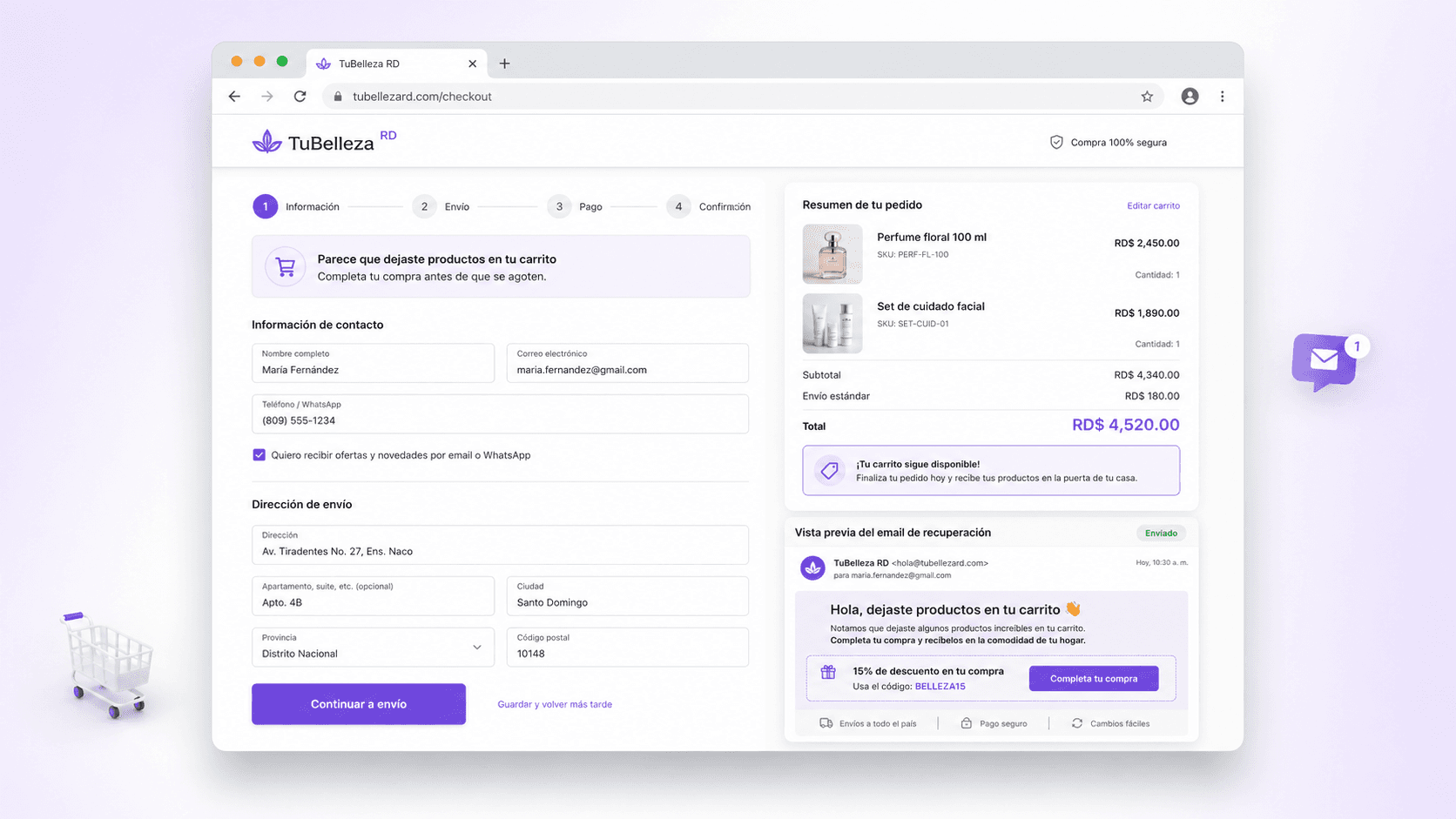
The payment step is where the sale is won or lost, and it can almost always be simplified. Let people buy without forcing them to create an account. Ask only for the details you genuinely need. Show the full cost — shipping and taxes included — early, not as a final surprise. And keep the pay button visible, large and unambiguous. A checkout of one or two steps converts considerably better than one of five. That isn’t aesthetics: it’s conversion engineering.
The second fix: payment methods
A store that only takes one kind of card is leaving sales on the table every day. Accepting the major cards, the digital wallets people already have set up on their phones, and — where it fits your market — installments or pay-by-link, removes the customer’s excuse that they have no way to pay you here. Every missing payment method is a group of customers walking away. Building those connections properly, so they charge without failing, is real engineering work, and it’s what separates a display window from a store that actually collects.
The signal many forget: the receipt
A store that produces a clean receipt for every sale, with tax calculated correctly and sent automatically, doesn’t just keep your books straight: it reads as serious. A customer who gets their receipt in order trusts you more, and you avoid the mess of reconstructing months of orders by hand later. Leaving the store ready to issue its own receipts is part of taking payment properly.
Before you recover, check the basics
Before you set up cart recovery, make sure your checkout isn’t the thing scaring customers off. Use this list to audit your store today:
Is your checkout ready to take the money?
Check what your business already does.
How to bring back the one who already left
Not every abandoned cart is lost. A customer who left an email address can be recovered, and at a decent success rate:
- A recovery email. An automatic message, an hour or two later, reminding them what they left in the cart, with a link to finish the purchase in one click. It’s the most profitable tool an online store has.
- A measured incentive. Sometimes free shipping or a small discount in that second email closes the sale. Measured, not given away: don’t train your customers to abandon carts so the price drops.
- A text reminder. Where the customer has opted in, a message to their phone can land harder than an email. Operated with judgment, not as spam.
- Retargeting. Showing them your product again while they browse elsewhere, so it doesn’t slip their mind. It works when it’s done in moderation.
What you can’t see: measuring to improve
You can’t fix what you don’t measure. A serious store knows the exact step where the customer drops: whether they leave when shipping appears, whether the payment fails, whether the phone stalls. With that data you decide what to fix first instead of guessing. Underneath, a well-run operation uses its own intelligence to spot where the sale leaks and act on it. It isn’t about applying patches at random — it’s about running the store on numbers.
Trust gets built too
A customer buying online wants a reason to trust you before handing over a card. Clear shipping and return policies, a contact email on your own domain, reviews from other buyers and the logos of the cards you accept all reduce hesitation at the exact moment of decision. Trust isn’t decoration: it’s what turns a curious visitor into a buyer who finishes paying. Every missing signal of seriousness is one more excuse to abandon the cart.
The short version
Abandoned carts aren’t the customer’s fault: they’re the warning that something in your store stopped them right before payment. A simple checkout, the payment methods people actually use, a receipt in order, visible trust and automatic recovery for the ones who left — each of those fixes rescues sales that were already nearly closed. It isn’t magic, it’s building and operating the store so it closes.
We build and operate online stores that take payment cleanly, recover lost sales and keep growing. Take a look at our online store service, or build your project in minutes and get an estimate shaped around your business.
We do not just write about this. We build it and we run it.
Stores, integrations, websites and intelligence already in production. Serving North America and LATAM since 2008.