In an occupational health clinic, the bottleneck is almost never the appointment. It is everything that comes after. The physician evaluates the worker in minutes, then loses the better part of an hour transcribing studies, reading labs, audiograms, spirometry and EKGs, drafting the certificate, assembling the file and getting the invoice ready. Multiply that by thirty evaluations a day and the whole business ends up hostage to paperwork. That frustration is where Aptico came from — one of the platforms we build and operate in production. We are not telling the story to sell you Aptico. We are telling it to show how a real system gets thought through, built and held up, because that is exactly the muscle we put at your disposal when you need one of your own.
The problem, before anyone thinks about a solution
Before writing a single line of code, you have to understand the trade. An occupational health evaluation is not a form: it is clinical judgment applied to scattered data. Studies arrive in different formats, from different machines, with results that only mean something once someone qualified reads them together. Any system can automate paperwork; the hard part is automating judgment without losing rigor. When the system gets a finding wrong, it is not a pixel that breaks — it is a worker's health and the clinic's legal exposure. So the first job was not technical. It was learning what a physician decides, in what order, and where no shortcut is allowed. That diagnosis — of the process, not the patient — is the invisible half of any serious system, and the half most often skipped when somebody codes in a hurry.
How it gets built
Aptico reads each study, structures it, interprets it against clinical criteria and proposes the result. The physician does not transcribe: the physician confirms. That one word is the entire architecture of the product. The system does the heavy lifting and leaves the final decision in human hands, where it belongs. Building that properly takes several pieces fitting together without friction:
- Reading studies that arrive in every format. Labs, audiometry, spirometry, EKG: each one comes in as it comes, and leaves structured, with its findings ordered and legible.
- Clinical criteria built in. Pulling out numbers is not enough; you have to know what they mean together. That intelligence, sharpened over years of engineering, is what turns data into an evaluation.
- Documents that hold up. Certificate, file and invoice are assembled with a single signature, ready and auditable.
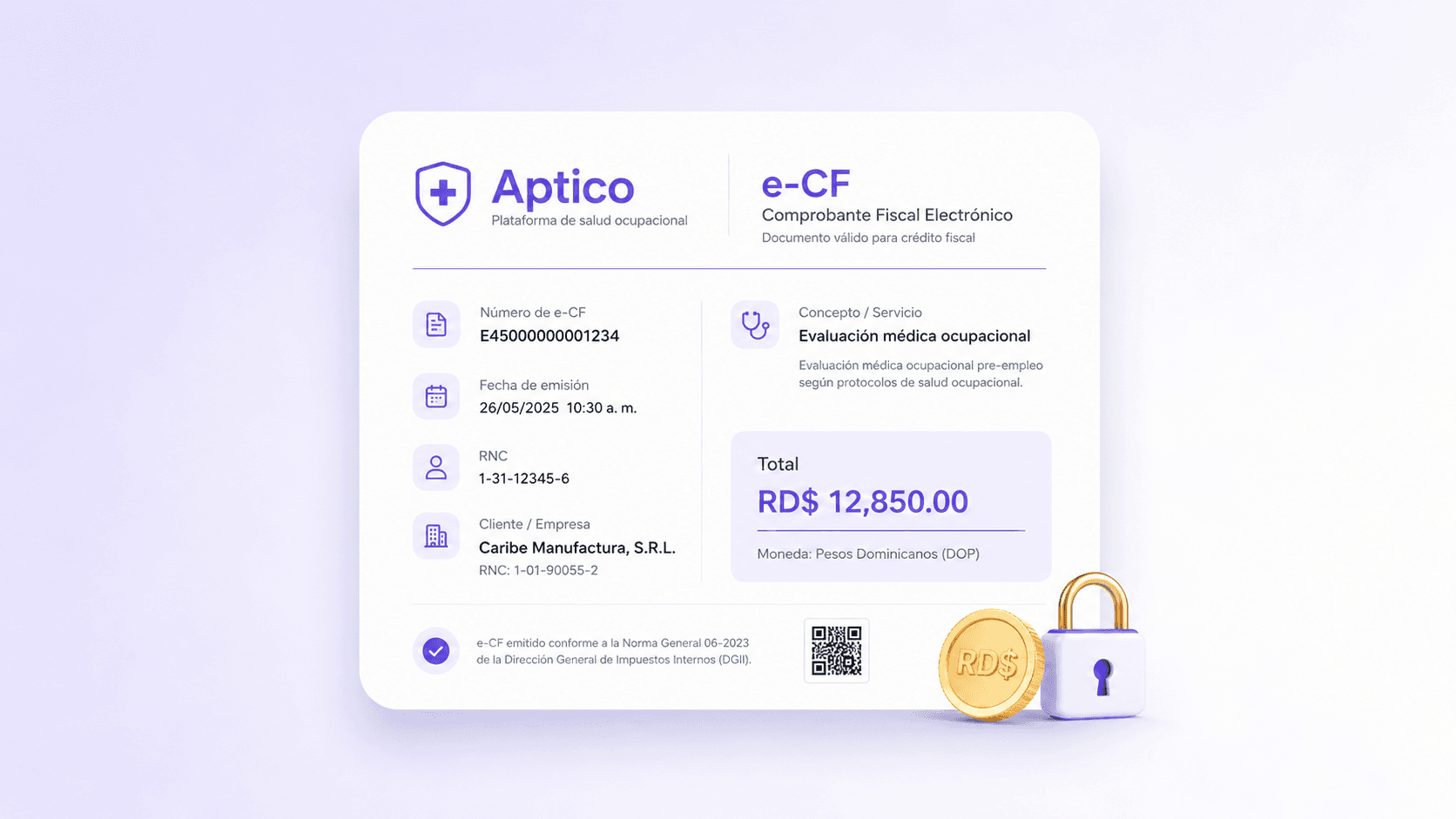
- Billing that comes standard. Every certificate is born ready to be billed, with no loose steps and no copying and pasting into a second system.
The intelligence behind all of this is not a trick or an experiment: it is proprietary engineering already running every day against real evaluations. We do not open the hood, the same way a manufacturer does not walk you through the engine. What matters is that it works, that it holds up under load, and that the physician trusts what appears on the screen. That trust is not requested, it is earned, and it gets earned when the system is right again and again on real data, not demo data.
How it gets operated
Building a system is the easy half. The hard half is operating it: making sure it loads fast at eight on a Monday morning with a full waiting room, that it never loses a file, that it updates when a regulation changes, that it absorbs growing volume without the clinic ever noticing something was adjusted underneath. Software that gets handed over in a .zip and abandoned does not solve the problem; six months later it is broken and the clinic has nobody to call. Aptico is in production because someone watches it, improves it and answers for it. That is the difference between building software and operating software, and it is the only difference that matters when the system carries your operation day after day. Whoever builds and walks away leaves behind a problem more expensive than the one they came to fix.
Why billing is not a footnote
Billing is worth a stop, because it shows how a complete system gets thought through. A platform that produces certificates but forces someone to re-key every invoice somewhere else did not finish the job: it left it half done and handed the friction to the customer. That is why Aptico was wired to billing from the start, not patched later. Meeting the rules a business actually operates under — from day one, rather than as a last-minute scramble — is part of building well. The same applies to any system: a requirement is not an obstacle to dodge later, it is a condition you design for from the first stroke.
What this means for your business
You may not run an occupational health clinic. It does not matter. What Aptico proves transfers to any operation that depends on a serious system: understand the trade before you code, automate the heavy work while leaving the decision in human hands, connect pieces that live in separate systems, meet your requirements from the start, and stay to operate what you built instead of disappearing at handover. If your business has a process eating hours of your team's week — evaluations, files, quotes, dispatch, collections — that process can become a system that frees them and multiplies your capacity without adding headcount. That is the work we do: software built to fit a real problem, with the same discipline we apply to our own, and operated with the same seriousness.
See the systems we build and operate under our own products. If your business needs one built to fit, take a look at how we approach custom software development — or build your project in minutes and get an order of magnitude on the spot.
We do not just write about this. We build it and we run it.
Stores, integrations, websites and intelligence already in production. Serving North America and LATAM since 2008.